

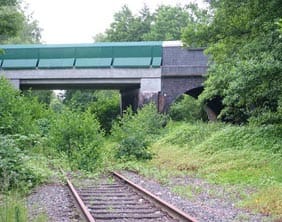
The Lichfield to Walsall railway line is a distant memory to most, but ever since it closed to passengers in 1965 as part of the Beeching review rumours of its reopening have been rampant.
However, even up until the line was officially closed to the freight services in recent years, no sign of re-instated passenger services has materialised.
But the decision to install a bridge rather than remove the track near the Chesterfield Road development in Lichfield has once again stoked the fire of interest in the line.
Any potential reopening of the line would create interest not only in Lichfield, but in other areas which could benefit from stations along a reopened line – including Burntwood and Brownhills.
But as blogger BrownhillsBob reveals in this guest post for The Lichfield Blog following a post on his own site about the future of the line, the benefits and the appetite for any reopening in Lichfield, may not quite be matched at the other end of the dormant line…
Residents of Lichfield will be well acquainted with the good rail links that serve their city – the Cross City commuter line serves as an excellent link to Birmingham, and the Trent Valley mainline provides services both local and long distance along the West Coast corridor.
There has been much talk about a third line of late, of which you may only be peripherally aware; the South Staffordshire line. Up until 2002, it was a working, truncated freight connection from the Cross City line to the former Charringtons oil depot on the A5 at New Town – previously it had linked the Black Country to Burton Upon Trent serving stations at Walsall, Pelsall, Brownhills and Hammerwich.
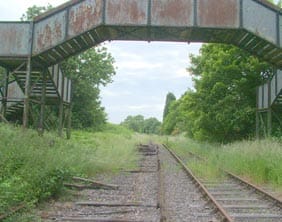
Passenger services along the line were once fast and frequent, until all passenger services along the route were axed as part of the Beeching review in 1965. The line remained fully in use as a freight route up until 1983, when the line officially closed between Walsall and New Town; in 1985 tracks were lifted and the line to the oil terminal was converted to a single track.
There has historically been quite a movement to reinstate the line between Walsall and Lichfield for passenger use. Several campaigns have been launched over the years, and transport authorities in both the West Midlands and Staffordshire have expressed support for the move, but regrettably, no money has ever been forthcoming.
The route the line followed – the track bed – is still intact between Walsall and Lichfield, and is classified as ‘mothballed but strategically important’ – this means that Network Rail, the landowners, won’t allow development to encroach upon it. That’s why the bridge over the line at Pipe Hill was rebuilt some years ago, and why new bridges have been added at no little cost, crossing the M6 Toll and new South Eastern Bypass.
Whilst this sensible act shows intent, it doesn’t signal imminent development, which is a tragedy.
Historical timetables for the latter days of passenger operation of the line show that in 1950, with three stops, a train could travel from Walsall to Lichfield in just 24 minutes. The only regular bus service left to cover that journey – the Arriva 61 service – runs through Brownhills, Chasetown, Chase Terrace and Burntwood, and takes a backside-numbing 60 minutes.
The former 991 service that ran directly along the A461 throughout the day has now been neutered to six journeys a day at peak times only. From this, it can be seen that there would clearly be a huge public transport advantage to reopening this line, and should services on it extend over existing lines to maybe Wolverhapton and Burton, valuable commuting links would be formed, reducing road traffic and making commuting between several close, but disconnected population centres viable once again.
I can also see potential advantage in expansion of the service north of Lichfield, with stations near Fradley, and possibly at Barton Under Needwood. Electrification of that route would not be financially viable, so operating a diesel service originating from the Walsall line to connect with the existing electric service at Lichfield city would seem to be a viable option.
With ribbon development of both housing and commercial nature ongoing along the A38 corridor, one would consider better public transport facilities to be imperative to the success of those projects.
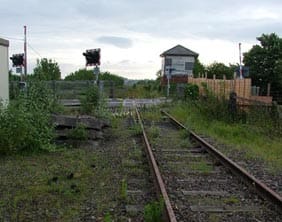
Regeneration of this lost transport artery became a step closer in June, with the publication of the Connecting Communities report by The Association of Train Operating Companies which set out an agenda for the reinstatement of lines and services across the country, including the Walsall to Lichfield line. The report sets out solid guidelines and aspirations, but is short on funding, and that’s where I think the project will fall down.
In Lichfield and its’ environs, there is unlikely to be huge opposition to the line reopening, but here in Walsall, some councillors, apparently already fearing a backlash have started badmouthing the project as unlikely and unaffordable. With the current financial restraints facing local authorities, coupled with the historical difficulty that seems to beset any project that crosses the boundary between the West Midlands and Staffordshire, I think that this project is sadly unlikely to come to fruition in the proposed form unless the government takes a hand.
I think the cause of better public transport is worth pursuing, and I’d really like to see the reinstated train service return. I think the line will be rebuilt, but probably in the first instance as a freight line; rail freight movement in the midlands is horrifically congested, and demand continues to grow. I can see real pressure for expansion coming from that sector, and maybe passenger utility could sneak in through that particular door instead.
I fear that if we rely on our politicians, they will continue to be long on words and short on actions, and we’ll all be the poorer.
For more information on the fight to reopen South Staffs Railway visit Kevin Ellis’ campaign site.


